SPEAK 307
A platform for Lincoln County WY and beyond.
To share truth, opinion, and accountability..
Who we are
Speak 307 is an independent Wyoming-based platform built to give a voice back to the people of Lincoln County and to communities across the state who believe in transparency, accountability, and open dialogue.
We are not a government entity, a political organization, or a corporate media outlet. We are citizens, business owners, and community members who understand that informed communities are stronger communities.
Our mission is simple: to create a space where facts matter, opinions are welcomed, and public actions are not hidden from public view.
What we do
Publish community-submitted perspectives, original reporting, and documented records that shed light on local decisions, public spending, and the direction of our towns and counties.
Ask questions about tax use, development projects, leadership decisions, and other public matters that affect everyday life.
Give straight forward points of view and opinions backed up by facts, documents and data.
Make information accessible so more people can participate in local conversations and decisions that affect lives and livelihoods.
Speak 307 exists because too many important conversations happen behind closed doors—or not at all. We aim to change that by opening the record, encouraging respectful, informed participation, and holding public actions up to public view.
Our principles
Transparency: Public actions should be visible, and records should be available to the people they affect.
Accountability: Leaders and institutions must answer to the communities they serve.
Free expression: We protect and exercise the rights of free speech guaranteed by the First Amendment, essential for transparency and an informed public.
Inclusion: No voice is too small, no question irrelevant, and no public matter should go unquestioned.
Wyoming citizens are unique in their independence, and Speak 307 reflects that spirit—local, grounded, and unafraid to ask hard questions. We are committed to strengthening our communities through information, dialogue, and civic engagement.
Public Submissions are welcome and encouraged!
E-mail speak307starvalley@proton.me
This site is privately operated by community citizens, your donation is appreciated.
ARTICLE 4 - PUBLIC MEETINGS WYOMING STATE STATUTE
16-4-401. Statement of purpose.
The agencies of Wyoming exist to conduct public business.
Certain deliberations and actions shall be taken openly as
provided in this act.
16-4-402. Definitions.(a) As used in this act:
(i) "Action" means the transaction of official
business of an agency including a collective decision, a
collective commitment or promise to make a positive or negative
decision, or an actual vote upon a motion, proposal, resolution,
regulation, rule, order or ordinance at a meeting;
(ii) "Agency" means any authority, bureau, board,
commission, committee, or subagency of the state, a county, a
municipality or other political subdivision which is created by
or pursuant to the Wyoming constitution, statute or ordinance,
other than the state legislature, the judiciary, the consensus
revenue estimating group as defined in W.S. 9-2-1002 and the
investment funds committee created by W.S. 9-4-720;
(iii) "Meeting" means an assembly of at least a
quorum of the governing body of an agency which has been called
by proper authority of the agency for the expressed purpose of
discussion, deliberation, presentation of information or taking
action regarding public business;
(iv) "Assembly" means communicating in person, by
means of telephone or electronic communication, or in any other
manner such that all participating members are able to
communicate with each other contemporaneously;
(v) "This act" means W.S. 16-4-401 through 16-4-408.
16-4-403. Meetings to be open; participation by public;
minutes.
(a) All meetings of the governing body of an agency are
public meetings, open to the public at all times, except as
otherwise provided. No action of a governing body of an agency
shall be taken except during a public meeting following notice
of the meeting in accordance with this act. Action taken at a
meeting not in conformity with this act is null and void and not
merely voidable.
(b) A member of the public is not required as a condition
of attendance at any meeting to register his name, to supply
information, to complete a questionnaire, or fulfill any other
condition precedent to his attendance. A person seeking
recognition at the meeting may be required to give his name and
affiliation.(c) Minutes of a meeting:
(i) Are required to be recorded but not published
from meetings when no action is taken by the governing body;
(ii) Are not required to be recorded or published for
day-to-day administrative activities of an agency or its
officers or employees.
(d) No meeting shall be conducted by electronic means or
any other form of communication that does not permit the public
to hear, read or otherwise discern meeting discussion
contemporaneously. Communications outside a meeting, including,
but not limited to, sequential communications among members of
an agency, shall not be used to circumvent the purpose of this
act.
16-4-404. Types of meetings; notice; recess.
(a) In the absence of a statutory requirement, the
governing body of an agency shall provide by ordinance,
resolution, bylaws or rule for holding regular meetings unless
the agency's normal business does not require regular meetings
in which case the agency shall provide notice of its next
meeting to any person who requests notice. A request for notice
may be made for future meetings of an agency. The request shall
be in writing and renewed annually to the agency.
(b) Special meetings may be called by the presiding
officer of a governing body by giving verbal, electronic or
written notice of the meeting to each member of the governing
body and to each newspaper of general circulation, radio or
television station requesting the notice. The notice shall
specify the time and place of the special meeting and the
business to be transacted and shall be issued at least eight (8)
hours prior to the commencement of the meeting. No other
business shall be considered at a special meeting. Proof of
delivery of verbal notice to the newspaper of general
circulation, radio or television station may be made by
affidavit of the clerk or other employee or officer of the
agency charged or responsible for distribution of the notice of
the meeting.
(c) The governing body of an agency may recess any
regular, special, or recessed regular or special meeting to a
place and at a time specified in an order of recess. A copy of
the order of recess shall be conspicuously posted on or near thedoor of the place where the meeting or recessed meeting was
held.
(d) The governing body of an agency may hold an emergency
meeting on matters of serious immediate concern to take
temporary action without notice. Reasonable effort shall be made
to offer public notice. All action taken at an emergency meeting
is of a temporary nature and in order to become permanent shall
be reconsidered and acted upon at an open public meeting within
forty-eight (48) hours, excluding weekends and holidays, unless
the event constituting the emergency continues to exist after
forty-eight (48) hours. In such case the governing body may
reconsider and act upon the temporary action at the next
regularly scheduled meeting of the agency, but in no event later
than thirty (30) days from the date of the emergency action.
(e) Day-to-day administrative activities of an agency, its
officers and its employees shall not be subject to the notice
requirements of this section.
16-4-405. Executive sessions.
(a) A governing body of an agency may hold executive
sessions not open to the public:
(i) With the attorney general, county attorney,
district attorney, city attorney, sheriff, chief of police or
their respective deputies, or other officers of the law, on
matters posing a threat to the security of public or private
property, or a threat to the public's right of access;
(ii) To consider the appointment, employment, right
to practice or dismissal of a public officer, professional
person or employee, or to hear complaints or charges brought
against an employee, professional person or officer, unless the
employee, professional person or officer requests a public
hearing. The governing body may exclude from any public or
private hearing during the examination of a witness, any or all
other witnesses in the matter being investigated. Following the
hearing or executive session, the governing body may deliberate
on its decision in executive sessions;
(iii) On matters concerning litigation to which the
governing body is a party or proposed litigation to which the
governing body may be a party;
(iv) On matters of national security;(v) When the agency is a licensing agency while
preparing, administering or grading examinations;
(vi) When considering and acting upon the
determination of the term, parole or release of an individual
from a correctional or penal institution;
(vii) To consider the selection of a site or the
purchase of real estate when the publicity regarding the
consideration would cause a likelihood of an increase in price;
(viii) To consider acceptance of gifts, donations and
bequests which the donor has requested in writing be kept
confidential;
(ix) To consider or receive any information
classified as confidential by law;
(x) To consider accepting or tendering offers
concerning wages, salaries, benefits and terms of employment
during all negotiations including meetings of the state loan and
investment board to receive education regarding and to interview
investment managers;
(xi) To consider suspensions, expulsions or other
disciplinary action in connection with any student as provided
by law;
(xii) To consider, discuss and conduct safety and
security planning that, if disclosed, would pose a threat to the
safety of life or property;
(xiii) To consider an individual student's
eligibility to participate in an interscholastic activity,
including the school activity eligibility commission's
determinative vote on the student's eligibility, pursuant to
W.S. 21-25-204, if the commission is in effect pursuant to W.S.
21-25-202.
(b) Minutes shall be maintained of any executive session.
Except for those parts of minutes of an executive session
reflecting a members' objection to the executive session as
being in violation of this act, minutes and proceedings of
executive sessions shall be confidential and produced only in
response to a valid court order.(c) Unless a different procedure or vote is otherwise
specified by law, an executive session may be held only pursuant
to a motion that is duly seconded and carried by majority vote
of the members of the governing body in attendance when the
motion is made. A motion to hold an executive session which
specifies any of the reasons set forth in paragraphs (a)(i)
through (xii) of this section shall be sufficient notice of the
issue to be considered in an executive session.
16-4-406. Disruption of public meetings.
If any public meeting is willfully disrupted by a person or
group of persons so as to render the orderly conduct of the
meeting unfeasible, and order cannot be restored by the removal
of the person or persons who are willfully interrupting the
meeting, the governing body of an agency may order the removal
of the person or group from the meeting room and continue in
session, or may recess the meeting and reconvene at another
location. Only matters appearing on the agenda may be acted upon
in a meeting recessed to another location. A governing body of
an agency shall establish procedures for readmitting an
individual or individuals not responsible for disturbing the
conduct of a meeting. Duly accredited members of the press or
other news media except those who participated in a disturbance
shall be allowed to attend any meeting permitted by this
section.
16-4-407. Conflict of law.
If the provisions of this act conflict with any other statute,
the provisions of this act shall control.
16-4-408. Penalty.
(a) Any member or members of an agency who knowingly or
intentionally violate the provisions of this act shall be liable
for a civil penalty not to exceed seven hundred fifty dollars
($750.00) except as provided in this subsection. Any member of
the governing body of an agency who attends or remains at a
meeting knowing the meeting is in violation of this act shall be
liable under this subsection unless minutes were taken during
the meeting and the parts thereof recording the member's
objections are made public or at the next regular public meeting
the member objects to the meeting where the violation occurred
and asks that the objection be recorded in the minutes.(b) If any action is prohibited both by this act and any
provision of title 6, the provisions of this act shall not apply
and the provisions of title 6 shall apply.
Make an impact on your community today.
We want to hear from you.
Public submissions are welcome and encouraged!
Share your story, experience with local government, concerns, battles and wins.We want to hear from you.
THIS PLATFORM IS INTENDED TO BE FOR THE PEOPLE, BY THE PEOPLE.
To submit an idea for an article, your article or important public information, E-mail: speak307starvalley@proton.me
This site is privately operated by community citizens. Your donation is appreciated.Opinion Page

When Public Service Starts Looking Like Private Gain
March 28 2026
Disclaimer: The following article is protected speech under the First Amendment to the United States Constitution and reflect the author’s opinions based on publicly available, information and legislative proceedings.
In small towns, trust is everything. We don’t have layers of bureaucracy to hide behind, and we don’t have the luxury of ignoring who makes decisions that affect our land, our money, and our future. That’s why transparency in local government isn’t optional — it’s required.
Lately, more people in our community are asking the same question: Who is really being served by the decisions coming out of our local boards and commissions?
According to the official minutes from the March 3, 2026 meeting of the Lincoln County Commissioners, a motion was passed approving a change allowing qualified retired Lincoln County employees under the age of 65 to have 50% of major medical premiums paid and 100% of vision and dental premiums covered under future insurance contracts. The motion, made by Commissioner Bowers and seconded by Commissioner Shumway, passed unanimously.
That decision alone creates a long-term financial obligation for taxpayers. Many residents in this county are struggling to pay their own insurance, yet the county continues to approve additional benefits that will ultimately be funded by the public.while de-funding insurance benefits for LC Weed and Pest employees.
Beginning in 2027, commissioner salaries are set to increase from $39,891 per year to $50,000 per year for each commissioner. Lincoln County commissioner paychecks will be $15,000 higher than State average and just $22,000 less than Teton County commissioners, despite the fact that Teton County has a far larger tax base and far greater revenue.
And these numbers… raise even more questions.
Between 2019 and 2025, Lincoln County Cash Reserves increased from $5,695,911 to $53,695,991 — an increase of 842.7%. To top it off, taxpayers are also funding a non-elected chief of staff position to the commissioners costing over $100,000 per year in salary alone.
Yet during that same period, budgets are being cut from county departments, EMS services are being placed in jeopardy, Lincoln County Weed and Pest employee benefits have been completely cut, $7,000 was approved to hire a “consultant “ to livestream commission meetings and for many residents property taxes have nearly doubled in less than three years.
Lincoln County is not Teton County.
Our taxpayers are fewer.
Our economy is smaller.
Our families are already feeling the strain.
Each decision on its own may seem reasonable. But taken together, these actions form a pattern. One benefit here, one increase there, one new position, one more obligation — until the total cost becomes something the public never fully agreed to carry.
This is just the tip of a much larger iceberg, and the weight of it is slowly pulling our valley down.
Should Public service look like private gain? Transparency should never be treated as a threat, and accountability should never be optional.
Are these decisions truly in the best interest of the people? Then they should stand up to public scrutiny, and taxpayers need to start attending the meetings.
This community isn’t asking for anything unreasonable.
We’re just asking for the truth.
People of this community, are you ready to take a stand for truth and transparency?
TAXPAYER STRUGGLES WHILE COUNTIES STOCK PILE $$$
When Property Taxes Feed the Government Machine
March 14 2026
Disclaimer: The following article is protected speech under the First Amendment to the United States Constitution and reflect the author’s opinions based on publicly available, information and legislative proceedings.
Most taxpayers think their property tax bill is simply the cost of funding local schools and services. Pay the bill, support the community, move on. But a lawsuit in Texas may expose something far more troubling — a system where appraisal districts, property taxes, school bond debt, and the municipal bond market operate together in ways most citizens never see.
The case, brought by Texas property owner Mitchell Vexler and originating in the 481st District Court in Denton County (Case No. 02-24-00305-CV), is not just about one tax bill or one disputed valuation. It challenges the entire structure that determines how property is valued, how taxes are imposed, and how long-term public debt is created and sustained.
At the center of the lawsuit is a claim that appraisal districts have the power to raise property values with little real accountability, knowing that higher valuations automatically produce higher tax revenue. Those tax revenues, in turn, are often pledged to repay school bonds — long-term debt approved by voters but frequently based on projections that depend on continually rising property values.
According to the filings, this creates a feedback loop. Higher appraisals support larger bond packages. Larger bond packages require higher tax collections. Higher tax collections depend on higher appraisals. The cycle feeds itself, year after year, with taxpayers locked into the result.
Vexler argues the case is not just about one homeowner’s dispute, but about whether the system itself has drifted beyond what the law allows. The lawsuit raises constitutional questions about due process, access to courts, and whether property owners are being forced into administrative processes that make it nearly impossible to challenge the underlying assumptions behind their tax bills.
If true, the implications go far beyond one county in Texas.
School bond financing, appraisal practices, and municipal debt markets are deeply connected across the country. When voters approve bonds, they assume the numbers behind those proposals are grounded in fair valuations and honest projections. When those valuations are inflated — intentionally or structurally — taxpayers may be committing to decades of debt without ever realizing how the numbers were built.
This is why the case matters.
It is not anti-school, and it is not anti-government. It is about whether the public finance system has become so complex, and so insulated from scrutiny, that ordinary citizens can no longer see how decisions affecting their property, their taxes, and their future are really being made.
Courts will decide the legal outcome. But the public should already be asking the larger question:
When a system depends on rising appraisals, rising taxes, and rising debt to sustain itself, who is actually in control — the voters, or the machine?
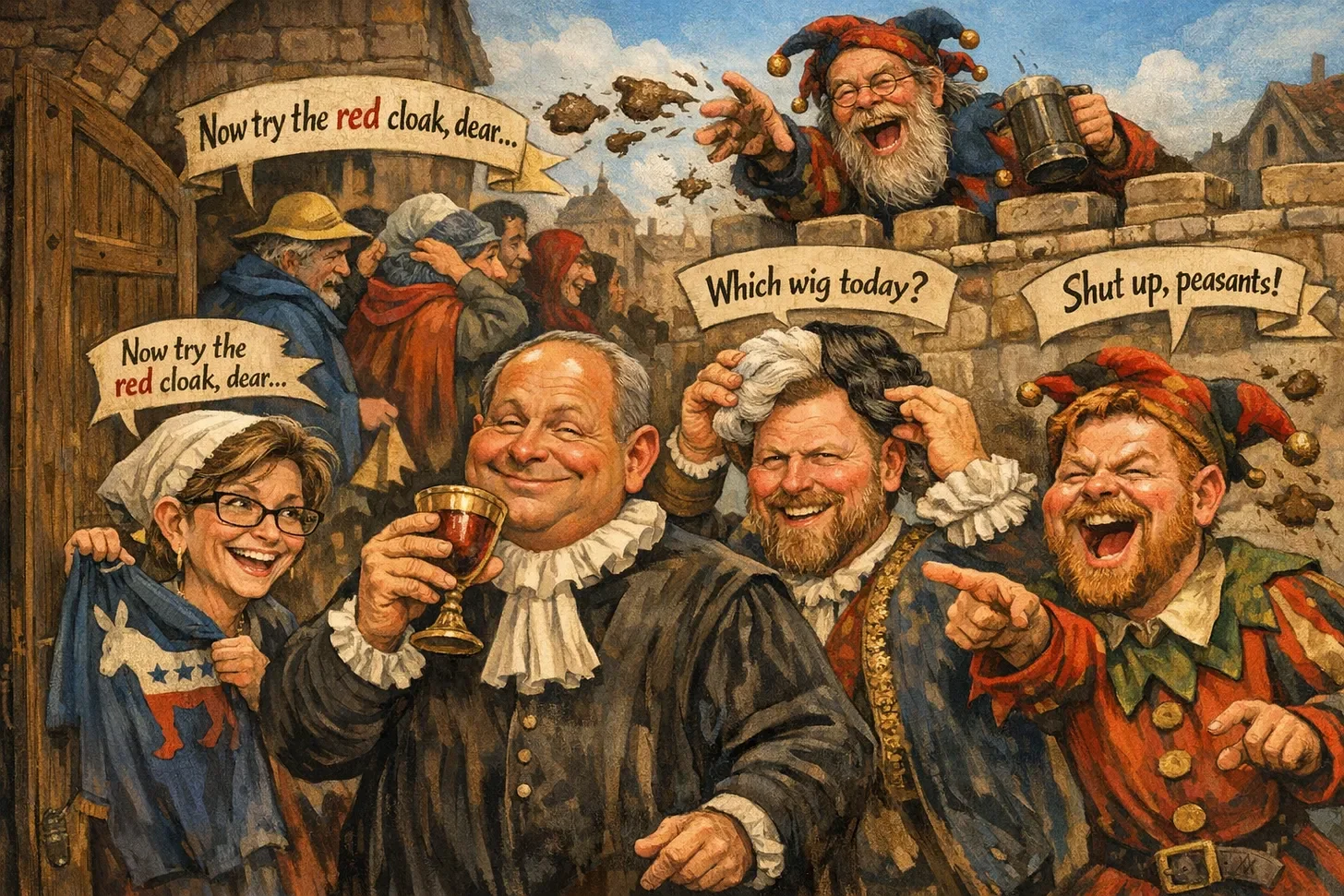
The Redcoat Court of the Wyoming Gentry
This piece is based on my personal observations of recent published columns by Gail Symons, Tom Lubnau, Lee Filer and Rod Miller. Symons, Lubnau and Filer’s columns were published in Cowboy State Daily; Miller’s was published in WyoFile. This is commentary, satire and opinion based on those public writings and the broader political patterns I believe they reflect.
There is a certain kind of Wyoming political creature that always appears when the grassroots gets a little too close to power.
They wear different costumes. They use different manners. But the job is always the same: protect the court, manage the peasants, and make sure the wrong kind of Republican, grassroots conservatives, never gets near the throne.
Meet the Court
In this court, every character has a role.
Gail Symons is the usher at the side door, smiling politely while waving crossover help into the Republican primary. In her recent column, she argued that unless you live in Teton or Albany County, or hold strong Democratic convictions, registering Republican and voting in the Republican primary gives you the greatest opportunity to influence who governs Wyoming. That is not party loyalty. That is Gail handing out wardrobe advice for political subterfuge.
Tom Lubnau is the silk-cuffed barrister, correcting the commoners in a measured tone and pretending contempt sounds better with table manners. In his recent column, he called Freedom Caucus claims “lies,” said the House “folded,” and delivered the usual establishment sermon that the loud grassroots types are all bluster and no substance.
Representative Lee Filer is the powdered-wig shape-shifter, changing lapel pins when the season requires it and then lecturing everybody else about “real conservatism.” His recent guest column did exactly that, scolding the Freedom Caucus in the language of stewardship and “true” conservative responsibility.
Cody Wylie is more like the junior court attack dog — the page who learned to snarl. In Cowboy State Daily, he wrote that Wyoming does not need “saving,” which is just a fresher packaging of the same old court-approved message: settle down, stop alarming the household, and let the respectable people handle things.
And Rod Miller? Rod Miller is the court jester.
Not the clever kind, either. He is not the kind who slips truth into wit. Rod is the kind who gets up on the banquet table, sloshes the ale stein, lets out a long theatrical belch, and mistakes the nobles’ laughter for applause.
That is the energy of his “bullshit” column.
In a recent column, Rod told readers to tune up their “bullshit detectors,” called Freedom Caucus Republicans “redcoats” and “drugstore cowboys,” and stomped around the page like a man who thinks vulgarity is the same thing as wisdom.
Tom does the same work with less spit. Tom dabs delicately at the corners of his mouth with linen. Rod belches at dinner and calls it frontier honesty.
But they are still eating at the same table, and it seems to me that table has a purpose: to keep the propaganda coordinated and make sure the same anti-grassroots garbage gets recycled through all their favorite media outlets — Cowboy State Daily and WyoFile.
The Propaganda Game
The game is to blur the line between parties, hollow out the Republican label, and make sure the Republican primary produces a court-approved Republican instead of an actual grassroots conservative who might read the platform and hold constituents in higher regard than the court does.
Gail says the quiet part out loud: register Republican, vote in the Republican primary, influence the result from inside the gate. That is the side door propped open for crossover traffic.
Tom Lubnau belongs here too, because every court needs a man who can sneer without raising his voice. Tom is the polished barrister explaining, with perfect table manners, why the peasants are too excitable to be trusted with the menu. He wraps the usual anti-grassroots contempt in civilized language. As Rod spills the ale, Tom sips the wine.
Representative Lee Filer’s public record shows he previously served in the Wyoming House as a Democrat in District 12 and later won House District 44 as a Republican. People can call that growth if they want. From where I sit, it looks more like a man changing powdered wigs and hoping nobody notices the sermon stayed the same.
Cody Wylie’s tone may be younger, louder, or dressed up in newer tricks, but the message is still familiar: the grassroots are the problem, the court must keep control, and the people who actually read the Wyoming Republican Party platform should probably pipe down and leave governance to their betters.
Rod Miller is useful to them because every court needs a fool. It needs somebody loud enough to mock the people the nobles find threatening. Somebody crude enough to turn contempt into entertainment. Somebody willing to squat on the castle wall, heckle the villagers, fling mud, and call it political philosophy.
That is Rod’s lane. He is the after-dinner entertainment.
The Brand and the Hustle
Meanwhile, the Wyoming Republican Party platform sits there in plain English: pro-life, pro-family, pro-second amendment, pro-property rights, pro-faith, pro-liberty, pro-business, pro-energy, pro-military and pro-American exceptionalism all rooted in a God-and-country worldview.
That is the brand of the Wyoming Republican Party.
The court’s job is to keep the Republican label while gutting out the platform.
So here is the scam in plain English:
Turn party registration into a costume party. Turn the Republican primary into court theater. Turn crossover meddling into civic virtue. Turn the platform into decoration, and make absolutely sure to turn the grassroots Republicans into the villain.
Then send out the court jester to belch through the banquet and shout out “bullshit” until nobody remembers who has actually been running the castle.
The redcoats are not the grassroots conservative Republicans who read the platform and expect candidates to mean it.
The redcoats are the ones at court, borrowing the label, policing the gate, and trying to save the Republican Party from grassroots conservative Republicans.
Gail holds the side door. Tom straightens the silverware. Lee adjusts his wig. Cody snaps at the help.
Rod gets up on the table and belches and flings mud, and somehow, they an expect the rest of us to clap.
Author’s note: This piece builds on my earlier commentary about Wyoming’s political gentry and the ongoing effort to manage Republican voters from above. You can read that earlier piece on The Open Range Record here:
https://www.openrangerecord.com/news/bd11d245-55c9-4737-84b7-22781e13d584
More @ Dawn’s Substack- Substack@dawnmarquardt

WYOMING’S 36 BILLION DOLLAR QUESTION
A Practical Guide to Civic Participation in Lincoln County, Wyoming
The Scarcity Lie, Federal Land Control…..
Who Owns the Soil in Wyoming?
Disclaimer: The following article is protected speech under the First Amendment to the United States Constitution and reflect the author’s opinions based on publicly available, information and legislative proceedings.
In Wyoming, the debate over land is never theoretical. It is legal, economic, and personal. More than half of the land in this state is controlled by the federal government, and nearly every major policy decision affecting energy, agriculture, wildlife, or development ultimately traces back to one question: Who controls the soil?
For decades, the public has been told that strict federal management is necessary because resources are limited. Grazing must be restricted. Energy must be regulated. Development must be slowed. Water must be allocated carefully. The justification is always the same — scarcity.
But that narrative is starting to fall apart.
Across the country, county officials, legislators, and landowners are increasingly questioning whether the real issue is not scarcity, but control. When Washington agencies hold authority over vast amounts of land, local communities are left with responsibility for the consequences but very little power over the decisions. (DOI SO 3447 Jan. 7, 2026)
This is where the idea often referred to as soil repatriation enters the conversation.
In policy terms, soil repatriation is not about ideology. It is about jurisdiction. The concept argues that land should be managed at the lowest practical level of government, consistent with constitutional principles of federalism and the equal footing doctrine that admitted western states into the Union on the same basis as the original thirteen.
Wyoming was not supposed to remain permanently under federal land dominance. Yet today, federal agencies such as the Bureau of Land Management, U.S. Forest Service, and Wyoming State Lands Board combined, controls millions of acres that directly determine the future of local economies.
That level of centralized authority affects everything from mineral leasing to grazing permits, from road access to wildlife policy, and from property values to tax revenue.
Supporters of soil repatriation argue that returning more authority to the states — or in some cases to counties — would not reduce stewardship, but strengthen accountability. Local governments live with the results of land decisions. They maintain the roads, fund the schools, and provide the emergency services that federal land does not pay for.
Recent conflicts over energy development, solar siting, and land-use planning in Wyoming show how quickly tensions rise when federal priorities override local needs. These disputes are not isolated incidents. They are symptoms of a structural imbalance that has existed for generations.
The so-called scarcity of land is not natural. It is policy-driven.
When access to land is limited by regulation rather than reality, economic growth slows, housing becomes harder to build, agriculture declines, and rural communities struggle to survive. Meanwhile, the land itself remains abundant.
That is why the current discussion about soil repatriation represents more than a political slogan. It reflects a growing demand to revisit the legal framework that governs land in the West.
If Wyoming is to control its own future, the question cannot be avoided any longer.
Who owns the soil — and who decides how it is used?


Jobs Before Tax Hikes
Gross Domestic Product.
is the standard economic measure to tell you if your economy is growing or declining.
46% of Wyoming Lives in a County with a Declining GDP
267,818 people in Wyoming live in a county with a declining GDP (out of a population of 586,722 (as of the end of 2024).
Here are the GDP results from end of 2018 through end of 2024 for the 9 counties in Wyoming with declining GDP:
- Sublette (population 8,949): -33.4%
- Platte (population 8,563): -18.7%
- Sweetwater (population 41,350) -17.6%
- Natrona (population 80,271) -10.5%
- Goshen (population 12,639) -10.1%
- Uinta (population 20,653) -6.9%
- Campbell (population 48,092) -6.5%
- Fremont (population 39,664) -3.0%
- Washakie (population 7,637) -.3%
Note: Wyoming Business Counsel has received nearly a billion taxpayer dollars to grow Wyoming’s economy, 46% of our state is not doing so well. WBC regional directors have ONE JOB - GROW YOUR REGION’S ECONOMY!
Is it possible that some of this decline could be associated with the 16.8% decline in Wyoming’s Mining Industry GDP and the corresponding 96% increase in the number of windmills and solar projects?
Lincoln County’s Scenario Tax tax tax and more TAX
YOU PAY FOR IT! So how is that working for you all….
Recent data shows that 46% of Wyoming residents live in counties with declining GDP. That should alarm every policymaker in the state. But here in Lincoln County, the warning signs hit even closer to home — and the response from leadership has been silence, tourism slogans, and now the looming discussion of new or increased taxes.
GDP — Gross Domestic Product — is the most basic measure of economic health. If it’s declining, your economy is shrinking. Jobs disappear. Wages stagnate. Young families leave. Property values stall. And yet, instead of focusing on meaningful job creation, Lincoln County’s economic strategy has leaned heavily on tourism, government programs, and public spending.
That’s not economic development. That’s economic maintenance — at best.
Responsibility for this failure is shared. County commissioners, town governments, local tourism boards, the Wyoming Business Council, and even our state Senate delegation all play a role in shaping Lincoln County’s economic future. Yet none have delivered measurable, private-sector job growth. Where are the new manufacturing employers? Where are the industrial relocations? Where are the year-round wage jobs that allow families to stay and build a future?
Instead, we’ve seen continued dependence on seasonal tourism dollars and public-sector expansion. Tourism has value, but it does not replace an industrial base. You cannot build long-term prosperity on hotel occupancy and event weekends alone.
Now, at the same time our economy struggles to diversify, taxpayers are hearing about potential tax increases. Whether through property tax adjustments, new levies, or expanded spending proposals, the conversation is shifting toward asking residents to pay more — before leaders have delivered meaningful economic growth.
That is backwards.
The proper order is simple: grow the economy first, expand the tax base second, and only then consider whether additional revenue is necessary. Raising taxes in a stagnant economy only accelerates decline. It discourages business investment, pushes working families out, and reduces competitiveness with neighboring states.
Lincoln County has real advantages. Available land. Strategic location. A skilled workforce. Strong communities. But those advantages require leadership willing to actively recruit employers, streamline permitting, support industry, and prioritize job creation over optics.
Residents should be asking direct questions: What companies have been recruited to Lincoln County in the past five years? How many year-round private-sector jobs were created? What industries are being targeted? What measurable goals exist? And why are tax increases being discussed before economic growth is achieved?
Lincoln County doesn’t need more studies, more branding campaigns, or more committees. It needs jobs. Real jobs. Until that happens, talk of higher taxes isn’t just premature — it’s irresponsible.

Our Republic, Our Responsibility

Restoring the Republic Starts at Home
Disclaimer: The following article is protected speech under the First Amendment to the United States Constitution and reflect the author’s opinions based on publicly available, information and legislative proceedings.
America was never meant to be ruled by distant bureaucrats, unelected agencies, or career politicians insulated from the people they supposedly serve.
Our Founders created a constitutional republic built on local self-government, citizen participation, and accountability. Yet today, many Americans feel powerless while federal overreach grows and local governments increasingly answer to state and federal interests instead of the people.
That is why movements like Tactical Civics are gaining attention among conservatives across the country. At its core, Tactical Civics is about restoring civic duty, constitutional authority, and the role of the citizen in self-government. It challenges Americans to stop behaving like spectators and start acting like the sovereign people our Constitution intended us to be.
For too long, conservatives have focused almost entirely on national elections while neglecting the local systems where real power often exists. County governments, sheriffs, grand juries, and local officials have enormous influence over daily life. Yet many citizens could not name their county commissioners or explain the constitutional powers held at the county level. That ignorance has allowed government expansion to flourish unchecked.
Tactical Civics argues that constitutional checks and balances only work when citizens actively participate. The Founders did not envision a passive population waiting for Washington, D.C. or local Government to solve every problem. They envisioned communities capable of defending liberty themselves through local action, civic knowledge, and moral courage.
Critics often dismiss constitutional grassroots movements as unrealistic or extreme. But
history tells a different story. The American Revolution itself was driven by ordinary citizens who believed centralized power had become abusive and unaccountable. The abolition movement, women’s suffrage, and the civil rights movement all succeeded because Americans organized locally before national change followed.
Conservatives should understand an important truth: liberty is not self-sustaining. Once
citizens stop participating, power naturally concentrates into fewer hands. That is exactly what has happened across America over the past several decades. Federal agencies regulate nearly every aspect of life, courts legislate from the bench, and local officials often avoid accountability altogether.Tactical Civics offers a reminder that the Constitution is not just a historical document—it is a blueprint for citizen responsibility. Freedom survives only when people are willing to defend it through peaceful civic engagement, informed participation, and local involvement.
America does not need more political celebrities. It needs citizens willing to attend county meetings, study the Constitution, question authority, and hold public officials accountable regardless of party affiliation.
The battle for liberty will not be won solely in Washington. It will be won—or lost—in counties, towns, and communities across America where citizens decide whether they still believe self-government is worth preserving.
Contact Us
Interested in working together? Fill out some info and we will be in touch shortly. We can’t wait to hear from you!